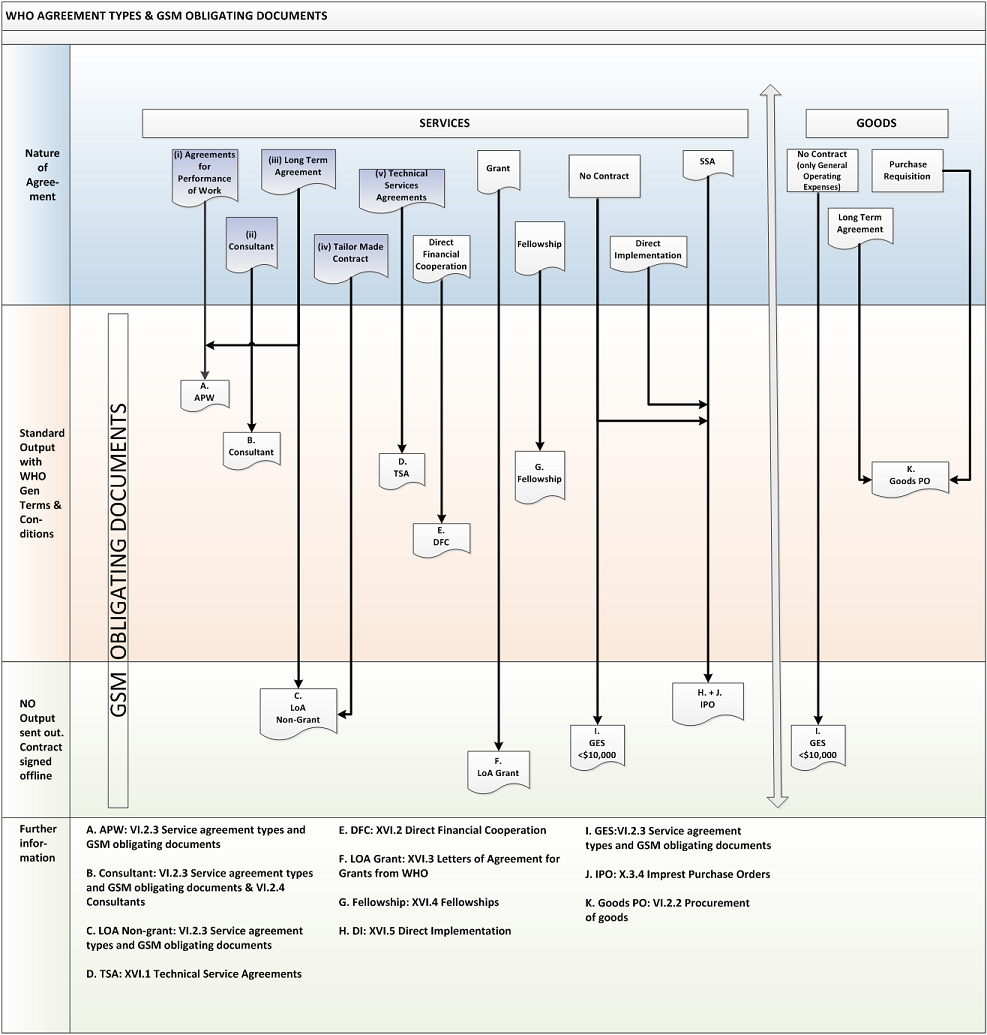
10 Part 1 of this section describes the agreements which can be used for the procurement of services. Part 2 of the section outlines the GSM obligating documents.
20 A schematic overview of all agreements types and GSM obligating document is found below:
Part 1 - Service agreement types
30 Part 1 of this WHO eManual section sets out the WHO procurement policy, and types of agreement to use, for the acquisition of services, whatever the source of funds or the use for which they are intended. Services of the types described in this section of the eManual may be provided by individuals, companies (firms), institutions or other non-profit organizations.
40 An adjudication report is required for all services procurement in excess of US$ 5,000. An adjudication report must justify the selection of a contractor in relation to other available alternatives in the market. Offers should normally be sought from at least three prospective suppliers or, in the case of procurement expected to exceed US$ 300,000, from as many prospective suppliers as possible. Cost, quality, reliability and availability to meet deadlines are important criteria to address and compare. Experience with WHO is not in itself a factor, unless it specifically contributes to the quality or cost of the work.
50 Any proposed procurement of services expected to exceed US$ 300,000 and any proposed procurement of services above US$ 50,000 for which a waiver of the normal competitive bidding requirements is requested, should be submitted to the Contract Review Committee. The Contract Review Committee should also be consulted where it can reasonably be expected that the work to be contracted is part of a larger piece of work to be performed by the same contractor, which will require a total contractual expenditure that may exceed US$ 300,000.
60 The types of agreements that can be used for the acquisition of services as described in this section of the eManual are: the Agreement for Performance of Work (APW), Consultant Contract, Long Term Agreement (LTA), Tailor Made Agreement (TMA) and in certain cases (as further explained below), the Technical Services Agreements (TSA).
If there is doubt about the appropriate agreement type to use, SUP (at HQ) or the Regional Procurement Officer should be consulted. The Office of the Legal Counsel (LEG) or the Director of Administration and Finance (DAF) in the regions may be asked to provide further guidance if needed.
Any request by a contractor to amend any of the general conditions applicable to WHO’s standard contracts (APW, Consultant Contract, TSA) must be referred to LEG. LEG should be consulted with regard to all Tailor-Made Agreements. LEG should also be consulted with regard to Long Term Agreements when standard contracting clauses in the approved LTA templates need to be amended.
Agreements which can be used for the procurement of services
(i) Agreements for Performance of Work (APW)
70 The Agreement for Performance of Work (APW) is used for arrangements whereby a specific product such as a report, an article, or translation and editing of a document is prepared and delivered; or technical services such as organization of a seminar is arranged by an individual or a firm, at the request of WHO, without direct supervision by an officer of the Organization. Normally, the individual contractor or firm will not carry out the work on WHO premises. Please refer to section III.16.2 Human Resources paragraphs 50 to 80 for additional information on the conditions under which Agreement for Performance of Work (APW) for individuals can be offered.
80 Agreements for Performance of Work should not be concluded for work which would typically be carried out under a Consultant Contract, i.e. work requiring direct supervision by a WHO staff member and possibly also presence on WHO premises for more than an occasional visit (see VI.2.4.40). In case of doubt, clearance should be sought from Director, Human Resources Management (or Regional Personnel Officer) before an agreement is concluded.
An individual or employee of a company hired under an APW shall not be related to a staff member who is responsible for reviewing and/or approving the commissioned work.
APWs may not be issued to WHO staff members. In signing the APW in his/her personal capacity, the contractor certifies that he/she does not (and will not during the term of the APW), hold any form of contractual relationship with WHO (including any WHO regional, country or project office, as well as any programme, centre or other entity where staff is subject to WHO Staff Regulations and Rules) that confers upon the contractor the status of a WHO staff member.
An individual contractor should not hold concurrent contracts with WHO unless the contracting unit or units can show that the overall work required of the contractor under the various contracts is less than 40 hours per week.
90 The General Conditions applicable to the APW are set out on the APW form generated automatically through the GSM procurement module. All parts of the APW form relevant to the particular service to be performed should be completed, including the project period, summary of the work, payment terms, and deliverables. If more detailed terms of reference or a separate budget are prepared, they must be attached as an Annex to the Purchase Requisition at the time of submission and filed electronically in the Records Management System (ECM).
(ii) Consultants
Management of consultant contracts is moving from section VI.2. Procurement of Goods and Services, to section III. Human Resources. The policies and manual sections are being rewritten to bring them into line with the HR framework and principles of competitive selection and contracting. In the interim, the provisions under section VI.2.4. Consultants remain valid with the exception of the sub-section on Submission to the Contract Review Committee (§ 160) and the role of Coordinator, GPL in the Global Service Centre in relation to the validation of requisitions (§ 180), which are no longer applicable.
100 A consultant is an individual who is a recognized authority or specialist in a specific field, engaged under a temporary contract in a technical advisory or consultative capacity. A consultant must have special skills or knowledge not normally possessed by the staff of the Organization and performs functions for which there is no continuing need in WHO.
The consultant is engaged for the purpose of performing a specific time-limited piece of work for WHO in a technical advisory or consultative capacity and normally:
a) The nature of the work requires the presence of the individual on WHO premises for more than an occasional visit; and/or
b) The work to be performed requires close WHO technical guidance; and/or
c) The work requires the individual to undertake travel for WHO, including to areas affected by disease outbreak or areas where a public health problem is prevalent.
110 Examples of the type of work for which a consultant contract should normally be issued are: the analysis of medical, scientific or other technical issues in countries; the evaluation of national health programmes; the assessment of disease outbreaks; the performance of disease outbreak activities; the assessment of compliance by third parties with WHO recommended standards (through site-visits); the provision of specialized health related training in countries, the filming of WHO activities in countries; and the performance of specialized IT related work on WHO premises. This list of examples is not exhaustive.
See section VI.2.4 for the policy and procedures applicable to the contracting of individuals as consultants.
(iii) Long Term Agreement (LTA) for the provision of services
120 A Long Term Agreement (LTA, also referred to as "umbrella" or "framework" agreement) is an agreement between the Organization and a supplier for the provision of certain defined services at a fixed price during a defined period of time (e.g. 2 or 3 years). An LTA does not constitute an obligation on the part of WHO to procure any (minimum quantity of) services from the company, nor does it prevent WHO from purchasing similar services from other sources.
130 LTAs are used to maintain one or more reliable sources of supply for services at a competitive price, in accordance with pre-defined terms and conditions. As noted above, the price for the services is fixed for the duration of the LTA. Each LTA includes the procedures for WHO to place specific orders for the services at the agreed price and the terms to which such orders will be subject.
LTAs may be raised with a single supplier or (in order to have multiple sources of supply for the same type of services) with several suppliers, and may include one or several services.
140 In the spirit of UN collaboration and harmonization of procurement procedures, the following clause (enabling UN agencies to benefit from the pricing negotiated between WHO and the supplier) should be included in the tender document and the LTA:
- the supplier shall offer the same prices and terms as those agreed with WHO to other interested UN system agencies and to organizations eligible to purchase through WHO (it being understood that each agency and organization will be responsible for independently entering into and administering its own contract with the supplier); and
- the supplier shall take into account the additional quantities of services purchased by all UN system agencies and other organizations as aforesaid to further reduce the priced for WHO and such other agencies and organizations.
(iv) Tailor Made Agreements (TMA)
150 A "Tailor Made Agreement" (TMA) is the general term used to describe an agreement with an external party, which is not a standard WHO agreement. It is used for the procurement of services where it is not appropriate to use an APW, Consultant Contract, TSA or LTA (for example, where a significant number of special requirements need to be included because of the type of work to be performed).
160 Tailor Made Agreements need to be drafted separately each time to fit the particular circumstances and requirements of the proposed activity. Therefore, it is important to consult with LEG at an early stage. As Tailor Made Agreements are non-standard, they always require clearance by LEG before signature.
(v) Technical Services Agreements (TSA)
170 A "Technical Services Agreement" (TSA) is an agreement for research or other technical projects/investigations. Technical Services Agreements (TSAs) which have been reviewed and recommended for funding by an established steering committee or similar established scientific or technical review body are exempt from WHO's rules on competitive procurement and Contract Review Committee (CRC) review. Those TSA contracts which have not been reviewed by an established steering committee, scientific or technical review body shall be subject to WHO's rules on competitive procurement and review by the Contract Review Committee (CRC).
180 TSAs should not be confused with Agreements for Performance of Work (APWs), which are intended for use in arrangements whereby a specific product such as a report, an article, or technical services such as organization of a seminar, or translation and editing, is prepared and delivered by an individual or a firm, without direct supervision by an officer of the Organization. In case of any uncertainty about whether the APW or TSA should be used in a particular case, LEG should be consulted.
190 TSAs are described in more detail in section XVI.1.
The General Conditions applicable to the TSA are set out on the TSA form generated automatically through the GSM procurement module. All parts of the TSA form relevant to the particular research or other technical project/investigation to be performed should be completed, including the project period, summary of the work, payment terms, and deliverables. If more detailed terms of reference or a separate budget are prepared, they must be attached as an Annex to the Purchase Requisition at the time of submission and filed electronically in the Records Management System (ECM).
Declarations of Interests
200 In accordance with the Guidelines for Declaration of Interests (WHO Experts), potential contractors must be requested to complete a Declaration of Interests (DOI) form if WHO depends on the independence and objectivity of the contractor in the provision of the services. The form can be found in Annex 7I of Guidance note 003: Procurement of Services. For more details, please consult https://intranet.who.int/homes/cre/ethics/doiexperts/.
Part 2 - ERP obligating documents
210 All procurement contractual agreements that commit WHO to pay for goods and services require an obligating document created within the ERP Procurement Module to reserve (encumber) the required funds before work commences and against which invoices can be paid. Certain agreements such as the Tailor Made Agreements and Long Term Agreements are processed in GSM by using an GSM obligating document which does not have an output for countersignature. Other agreements, such as Agreements for Performance of Work and Technical Services Agreements, are processed through GSM and result in a document that is countersigned by the supplier.
220 For the sake of clarity, all the different options available for encumbering funds through the GSM procurement module are described in the following paragraphs. This includes:
- those which are financial in nature (DFC, Imprest PO and Grant Letters of Agreement);
- General External Services which are used to encumber funds for purchases without a contract;
- Goods Purchase requisitions; and
- Consultant contracts which are human resource in nature.
A. Agreement for Performance of Work (APW) and Agreement for Performance of Work - Emergency
230 The Agreement for Performance of Work (APW) is both a contractual agreement document and a ERP obligating document. The APW contract generated by the ERP system is sent to the supplier for countersignature. The countersigned APW must be uploaded into ECM.
For further guidance see section VI.2.3 Agreements for Performance of Work. No work must be initiated before the APW is signed by WHO and the Contractor.
B. Consultant and Consultant - Emergency
240 The Consultants contract is both a contractual agreement document and a GSM obligating document. The Consultant contract generated by the GSM system is sent to the consultant for countersignature. The countersigned consultant contract must be uploaded into ECM.
For further guidance on Consultants see section VI.2.4 Consultants.
C. Letter of Agreement - Non-Grant
250 The Letter of Agreement Non-Grant is an internal commitment used for processing Long Term Agreements (LTA) for services and Tailor Made Agreements (TMA) in ERP. This ERP obligating document does not generate a contract as output that is sent to the supplier for countersignature.
The Letter of Agreement Non-Grant in ERP may only be used where a TMA or LTA exists. The countersigned TMA or LTA must be uploaded into ECM prior to commencement of work.
UN common service costs with a signed agreement and lease contracts are typical examples for application of the Letter of Agreement Non-Grant internal commitment. No work must start before the NGLOA is created in ERP
D. Technical Services Agreement (TSA)
260 The Technical Service Agreement (TSA) is both contractual agreement document and a ERP obligating document. The TSA contract generated by the ERP system is sent to the supplier for countersignature. The countersigned TSA must be uploaded into ECM. No work must start before the TSA is created in ERP
For further guidance on TSAs see section XVI.1 Technical Service Agreements.
E. Direct Financial Cooperation
270 Direct Financial Cooperation is both a contractual agreement document and a GSM obligating document. The DFC contract generated by the GSM system is sent to the supplier for countersignature. The countersigned DFC agreement must be uploaded into ECM.
For further guidance on DFCs see section XVI.2 Direct Financial Cooperation. No cooperation should start before the DFC obligation is created in ERP and signed by both parties (WHO and the Recipient)
F. Letters of Agreement - Grant
280 The Letter of Agreement - Grant is an internal commitment used for processing Grant Agreements in ERP. This ERP obligating document does not generate a contract as output that is sent to the supplier for countersignature.
The Letter of Agreement - Grant in GSM may only be used where an off-line grant agreement exists. The off-line grant agreement must either be based on the template available in the Grant LOA SOP (FIN.SOP.XVI.003) or cleared by LEG individually if non-template clauses are used in the agreement. The countersigned Grant Agreement must be uploaded into ECM prior to commencement of work.
For further guidance on Grant LOAs see section XVI.3 Letters of Agreement for Grants from WHO.
G. Fellowship
290 Fellowship contracts are internal commitment used for processing Fellowships in ERP. This ERP obligating document does not generate a contract as output that is sent to the supplier for countersignature.. No work should be started before the fellowshipobligtion document is approved in ERP
For further guidance Fellowships see section XVI.4 Fellowships.
H. Direct Implementation Imprest Purchase Order
300 A Direct Implementation (DI) Imprest Purchase Order (IPO) should only be initiated once it has been determined that other types of standard contracts (e.g. DFC, APW, GES) are not possible. The ERP obligating document is internal only and it does not generate an output to be signed or uploaded. No work should start before the IPO is approved in the ERP.
For further guidance on DI see section XVI.5 Direct Implementation.
I. General External Services
310 The General External Services (GES) is an internal commitment that does not generate a contract to be sent to the supplier for countersignature. Its purpose is to create an encumbrance in a WHO workplan, and an internal commitment against which the supplier's invoice(s) can be paid.
A GES can only be used to create an encumbrance for the payment of a service for which no written agreement exists and for which the supplier simply invoices WHO. Where a contractor refers in its quotation to its own general terms and conditions, LEG should be consulted prior to issuing a GES.
A GES can only be used for purchases up to a value of US$10,000 (apart from the exceptions stated below).
A GES can only be issued for services and for general operating expenses for which no written agreement exists.
Typical examples of purchases which can be processed by means of a GES are: registration fees for trainings, subscriptions, stationary and office supplies, postal fees, minor maintenance or repair works.
Typical examples of purchases which should not be processed by means of GES are: translation or editing services (use the APW), contracting of individuals for services (use the consultants modality).
The exceptions to the maximum permissible value of US$ 10,000 for GES are the following:
- Utilities contracts in those duty stations where only one provider exists and no contract is signed with the provider. When processing these by means of a GES, a justification must be uploaded in ECM.
- Special Services Agreements (SSA) contracts may be processed through a GES with no maximum limit.
- Meeting or conference room services and related costs. When processing these by means of a GES, a detailed quotation must be uploaded in ECM.
- Shared UN costs supported by an invoice only.
- Expenses incurred for the transportation of personal effects on repatriation or transfer to another duty station.
For guidance on SSA contracts, see section III.16.3 Special Services Agreements.
J. Imprest Purchase Order (Imprest/ Credit Card)
320 The Imprest Purchase Order (IPO) provides a means to procure from local suppliers and pay directly from the Imprest account when it is impractical, not feasible, or not possible to use the regular procure-to-pay process. The IPO is mainly used in Regional Offices and Country Offices. The IPO is an internal commitment that does not create a contract to be sent to the supplier for countersignature. Its purpose is to create an encumbrance in a WHO workplan mainly in country offices against which payments can be made. The IPO is also used for processing payments to individuals holding a Special Services Agreement (SSA) contract.
For further guidance on IPOs see section X.3.4 Imprest Purchase Orders.
For further guidance on SSAs, see section III.16.3 Special Services Agreements.
K. Goods Purchase Order (Goods PO)
330 A Goods Purchase Order (PO) is used for the procurement of goods. It is also used for the processing of Long Term Agreements (LTA) for goods. The Goods PO serves both as contractual agreement document and as internal commitment in GSM. The Goods PO which is generated by the ERP system is sent to the supplier for countersignature. The countersigned Goods PO must be uploaded into ECM. No goods should be ordered and delivered before the PO is signed by WHO and the Supplier
For further guidance see section VI.2.2 Procurement of goods.